Monday, February 27, 2017

Go Picasso!

Go Picasso

Picasso and the girl with a ponytail : 
a story about Pablo Picasso / by Laurence Anholt.


Animal Tails

Out of the woods : A True Story of an Unforgettable Event by Rebecca Bond.


Monday, February 20, 2017

Houses

'If the Walls Could Talk' 
a program about houses and homes. 

The Old House by Pamela Duncan Edwards. The group of kindergarten through fifth grade kids were very engaged. I had many more books to share so I book talked five more and all twenty-five books were checked out from my display. The Old House emotes in first person and through wonderful illustrations. 

The Craft

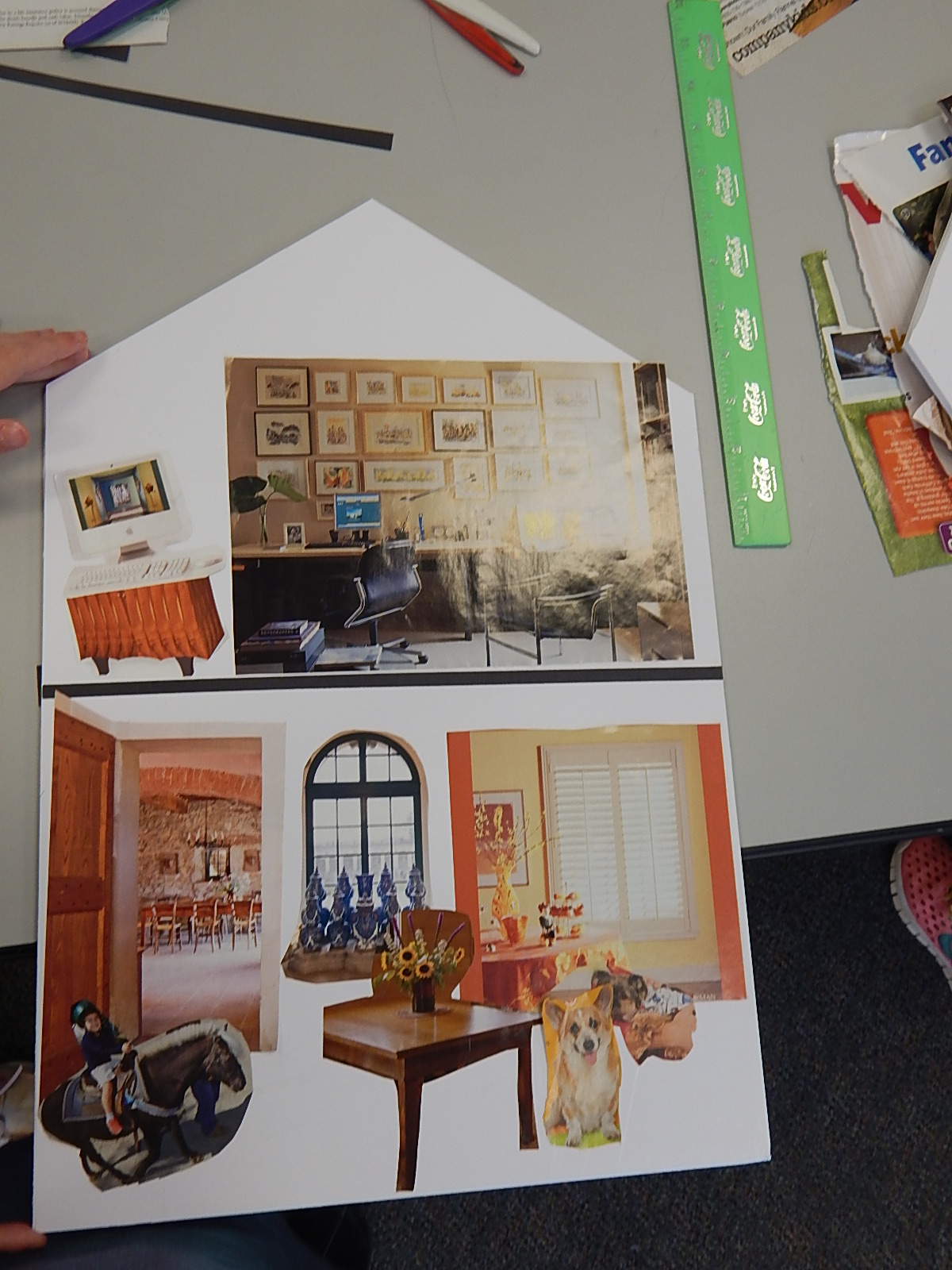
I cut foam core boards into the shape of a house with a pitched roof, I gleaned through many home magazines and made stations for home decorating. Electronics, furniture, kitchen, lighting, wallpaper, art and more were pre-cut and put in shallow pans. Before they began their craft I showed my example and demonstrated how to add levels to the house using strips of paper and ruler to make it look like a cut-a-way. The students worked for 35 minutes and thoroughly enjoyed the process and their outcome. 


Friday, January 15, 2016

Light the Night


Light the Night


I shared the book The shortest Day Celebrating the Winter Solstice
by Wendy Pfeffer, published 2003
It is a good read aloud for school aged students the book  explains the science of the shortest day and the myths that early cultures had during the shorting of days. Early astronomers began marking the shortest day and Romans, Druids and Swedes celebrated and had festivals. In Peru they honored the sun and carried fire to their temples and kept them burning through out the year. It touches on modern life with a scene of Christmas. In the back are facts and activities to mark and celebrate the solstice.
In addition I had several nonfiction books about how we celebrate holidays in this time of year, I asked the children how they celebrate their winter holiday and we talked about the way that light is brought into the celebrations.

The Craft

 I cut cardboard on the paper cutter into 4 inch squares and hot glued them together. We had scraps of glitter card stock and glitter foam sheets that I cut in angler shapes. I showed my example and demonstrated how they could fit the pieces together, We had a glitter station and then I hot glued their glass votive to their star base.


My demonstration.


Saturday, January 2, 2016

DRAGONS

DRAGONS

With so many cool dragon books in the children's collection I did a program all about dragons. I presented  a overview of the types of dragons using Gail Gibbon's book Behold...the Dragons. 


The students knowledge of dragons was impressive. I read You've got dragons by Kathryn Cave which appealed to the K-3rd graders that were in attendance. 


The Craft
I pre-cut black poster board using the technique of drawing a dragon face and folding it in half then cutting it on the better side- as you would cut a paper heart. That way the face was symmetric. We had a lot of wall paper for scrap booking that was pre-cut for a library festival booth making dragon kites. I was able to use those for this craft. The fun part was drawing the scales using metallic markers. There was a very low turn out and the three children were very diligent in creating there dragon heads. I started the scale pattern on the ears down to the brow. 


My example                                                                                      Colin- 3rd grader

Violet - kindergartner 


                                                      Andrew- kindergarten

Tuesday, October 13, 2015

Man in the Moon


I read If you decide to go to the Moon by Faith McNulty, illustrated by Steven Kellogg. It is an excellent and informative read aloud for school aged students


The Craft

I own a weeded coffee table book that I bought at the library. The book, Full Moon has beautiful photographs of the moon's landscape that I tore out of the book. The students were able to choose a page and glue their space explorer and ship on the page. A week prior to the program I emailed the contact parent and asked them to send a digital photo of their child. From the photos i corrected the size and cropped the image to surround the face. I captured, reduced and printed coloring sheet images of an astronaut and space ship on card stock paper. Then, I cut out the ships and space suits carefully cutting out the mask to fit their photos in. They colored and glued. It was pretty simple. I did tell them to glue the ship on or near the horizon in order for it to be in scale to the astronaut. 


Photo Op 
A coworker and I made this paper moon a few years back for Summer Reading. We used it for a photo booth. I recycled the idea and almost perfected my technique in Photoshop. Here are a few. I sent the photos to the parents as an email attachment. I received several thanks in response. 


Wednesday, November 26, 2014

FOXES

What does the fox say on a chilly night?


The fox Went Out on a Chilly Night by Peter Spier was published in 1961 and was republished in 2014. When I saw the new republication in 2014 I knew right away I wanted to do a program on the fox. and includ the recent publication of What Does the Fox Say?  My concern with Peter Spiers' book is that it is small and the beautiful drawings are so detailed. When I found that the Weston DVD, Dem Bones, had the video of The fox went out on a chilly night, it it was settled. I read the book first so the children could adsorb the text, then I played the sing a long animated video. I must say that some of the children were horrified as the fowl were eaten, bones and all and Thanksgiving is just around the corner. I saved What does the fox say? for the end of the program and I played Ylvis and sang along with the book. Several of the boys knew the dance moves to the song, so I had them come up front and lead everyone. We had a book dance party. 


The Craft


I found a great site that showed a fox drawing for kids and made a copy for each K-5 student . I also had saved 20 sheets of 8.5 x 11 heavy cardboard from our summer reading handouts.So we had a neutral firm background to take a lot of crayon and oil pastel coloring. I limited the color palette and gave each child the crayons they needed. I demonstrated the steps and they did a great job following the steps. After they completed their drawing and colored it in I gave them pastels to finish up their art. I did allow 30 minutes for the art project and they used it all.  


They didn't quite get the heavy use of the black outlining as I showed them, I guess their little hands were worn out. During the craft time I played "The Fox" from Best of the Land of Nod by the Waco Brothers, "The Fox" from Tumble Bee by Laura Veirs and "The Fox" by and from Little Mo' Mccoury. All different versions and two songs made into books. One old and one new. I sent the children home with a trail mix snack wrapped in a fox tail made of fuzzy pipe cleaner and cotton ball tuft hot glued on. All were happy as they left and one boy will be getting an oil pastel set for Christmas. 


Saturday, November 8, 2014

Spider and the Fly

Spider and the Fly


The Spider and the Fly went well with 15 students K-5th grades. The interesting aspect of this program was the archaic language of the 1899 poem by Mary Howitt, The Spider and the Fly. A few of the students were frightened by the poem so afterwards I helped them shake off all the creepiness by simply having them shake their hands in the air while saying "Shake it off!" in silly voices. Now it's time for silly story!  Hi Fly Guy by Ted Arnold was the natural choice. I ended our hour up with Thelonius Monster's sky-high fly pie: a revolting rhyme by Judy Sierra while the students ate homemade Shoo- Fly pie. They loved it and I handed out many recipes. 


The Crafts


I demonstrated how to draw a spider web at the beginning of the program. Before I read the poem I went over some “old” vocabulary words that are in the poem while they were drawing spider webs on their paper plates. I was surprised with their curiosity and interest to learn “old words” but it really helped their understanding of the cautionary poem as I read it. Then we made a spider and fly using black grapes, raisins and spaghetti. The wings on the fly are flatten golden raisins. 

 Fly Guy


Fly Guy's  is made from brown modeling clay. I attached the basic clay shape to small wooden dowels before the program. Each child was given two Mentos for the eyes and wings cut from plastic cups, uncooked spaghetti and a ball of clay for the nose. They drew the pupils with a Sharpie marker. 


A few props and my Shoo Fly pie. The motivation for this program were to use up and give away a surplus of raisins we had in our pantry. Mission accomplished. 


Friday, September 19, 2014

The Story of Salt


This September starts a new season with Creating with Books and I decided to recycle my first program presented in February of 2007 , Salt: What's Shaking?
 I had 15 students mostly k-3 grades and a few 5th graders.
A good icebreaker is to introduce figure of speech that refer to salt like - salt of the earth. There are many sites that give reference to this and facts about salt. 
I read experts from The Story of Salt by Mark Kurlansky. It is a very readable informative book on salt's value to all living beings, the impact salt had on historic civilization including settlements, revolution and war. We talked about salt as we know it today. We tasted crackers with and without salt.
I read 

We made mazes with salt and later made salt paintings.


The salt paintings originally were to be salt sprinkled on wet watercolor creating pattern bursts. The day before the program I experimented and it flopped, my husband is an artist and we exprerimented at home and found that you need to use high quality watercolor with actual dyes in the pigment.  I moved to plan B, and that was to draw shapes on the watercolor paper with glue then sprinkle the shapes with salt, shaking off th excess and letting them dry. The kids then painted the pictures with watercolor paint and were happy to see how the salt asorbed the paint.